





An idea with deep roots
It all began with collaboratories – a blend of collaboration and laboratory – a concept formalized in 1993 by William Wulf [1] to describe “centers without walls”, where researchers located in different places could work together remotely, sharing data, tools, and results. This insight anticipated many of the features that characterize today’s modern Virtual Research Environments (VREs). In this evolutionary process, the Italian National Research Council (CNR) – and in particular the Institute of Information Science and Technologies “Alessandro Faedo” (ISTI) in Pisa – played a pioneering role, actively contributing to the development of advanced digital environments for collaborative research. [2] Today, this vision finds concrete application in the FOSSR project, which, following the path successfully taken by other research projects and infrastructures, provides the scientific community with a VRE designed to foster openness, sharing, and reproducibility in social sciences research.
What is a VRE?
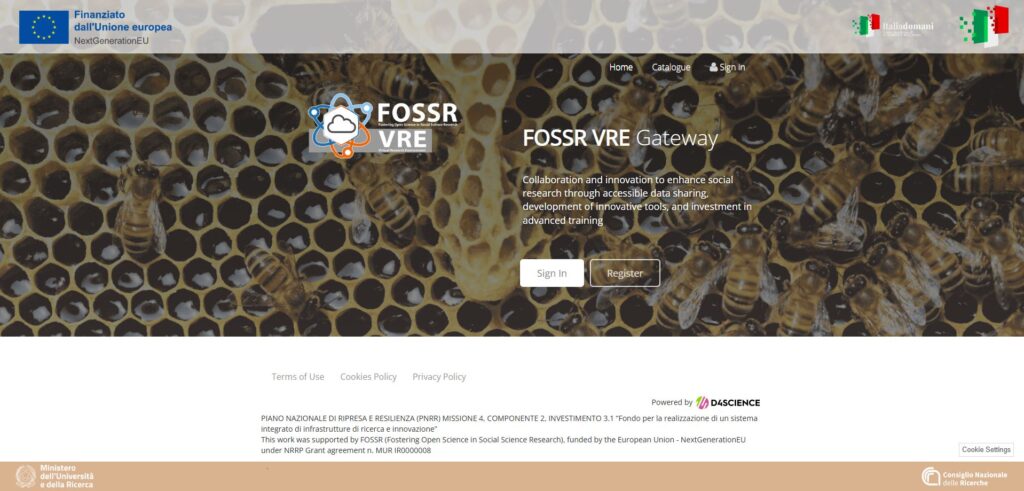
But what exactly is a VRE? Biagio Peccerillo (CNR-ISTI) explains: “A VRE is an integrated digital environment that brings together a range of services useful to researchers in their work. Its key components are, first of all, a workspace, that is, a remote and shared space for storing files and research outputs; computational resources to conduct reproducible experiments through environments such as Jupyter Lab and RStudio; a social component, functioning as a private social network that facilitates communication and project coordination; and finally a public catalog, which makes it possible to share articles, drafts, datasets, algorithms, and other research artifacts”.
More than a cloud: an integrated environment for research
At first glance, a VRE may resemble a standard cloud service. In reality, the main difference lies in its level of integration. “A traditional cloud – Peccerillo continues – can be seen as a simple remote file system: a place where files are stored and shared in folders. The strength of a VRE lies in integrating this service with many other functions”. For example, the environment allows project updates to be published in a shared space: a researcher can announce the availability of a new article draft, invite colleagues to comment on it, and directly link additional materials such as datasets or experimental environments. “If a draft contains an experimental section, a link to the experiment in the virtual lab can be added, including input data and expected results, so that anyone can replicate it. In addition, the catalog presents research outputs in an organized and indexed way, going beyond the simple folder navigation typical of a cloud service”. Access is provided through single sign-on authentication: once registered, users can immediately access all available services and begin collaborating.
At first glance, a VRE (Virtual Research Environment) may resemble an online platform for working collaboratively at a distance. In reality, its role is much broader: it is a digital space co-created and developed by its users that supports a specific team of researchers through all stages of their work, from sharing ideas to producing and disseminating results.
Within a VRE, the focus is not simply on exchanging files, but on building a collaborative environment in which data, tools, and activities are shared and interconnected. “For example, a researcher can openly share the implementation of a scientific workflow by linking it to an article that describes it and reports results obtained using specific datasets and configurations. Colleagues can easily replicate the study without dealing with computational issues, share comments and additional results obtained by applying the same workflow to different data, or a revised version of the workflow to the same sample data from the original study. The platform not only makes it possible to verify or reproduce a study, making research more transparent and reliable, but also makes the scientific production process more efficient by promoting the reuse and sharing of its various components, as datasets, code, observations, ideas”.
In summary, a VRE is not just a collaboration tool, but a true digital ecosystem that facilitates research work, improves knowledge sharing, and fosters new forms of collaboration.
The infrastructure supporting FOSSR’s VRE
From a technological point of view, VREs are distributed web applications hosted on high-performance data-centers. The VRE developed within FOSSR relies on the D4Science infrastructure, managed by CNR. [3] The main D4Science node is located at ISTI in Pisa, but the infrastructure as a whole is distributed across five geographic sites: the D4Science data-center in Pisa, three GARR network facilities, and one site on Google Cloud Platform. This architecture provides significant computational resources: 11,700 CPU cores, 82 TB of RAM, and 1,720 TB of storage. Currently, diverse scientific communities – ranging from agriculture to social sciences – use D4Science VREs to carry out innovative projects, demonstrating how data sharing can accelerate scientific progress. For FOSSR, this technological foundation is essential: the project does not simply offer a digital space, but aims to build an ecosystem in which data, tools, and methods can be shared in a structured and sustainable way.
The goals of the FOSSR VRE
FOSSR’s VRE was created with clear ambitions: strengthening the culture of open science and making the reuse of scientific results easier. “The goal – Peccerillo explains – is to encourage researchers to make datasets, algorithms, and experiments publicly available, increasing accessibility and reproducibility in social sciences research”. The system also aims to create a shared pool of resources from which new researchers can start, improving existing work or applying it to new contexts. “This creates a virtuous cycle of sharing: the entry barrier for newcomers is lowered, understanding the state of the art becomes easier, and reproducibility improves, which today is often limited by the lack of access to algorithms or datasets associated with scientific publications”. Sharing also has a direct effect on research impact: “Making data and tools available means increasing the use, dissemination, visibility, and citation impact of results, with benefits for the entire scientific community.” [4]
[1] Wulf (1993), “The Collaboratory Opportunity” DOI: 10.1126/science.8346438
[2] Candela, Castelli, Pagano (2013), “Virtual research environments: an overview and a research agenda” DOI: 10.2481/dsj.grdi-013
[3] Assante, et al. (2019) “Enacting open science by D4Science” DOI: 10.1016/j.future.2019.05.063
[4] Assante et al. (2023) “Virtual research environments co-creation: The D4Science experience” DOI:10.1002/cpe.6925