





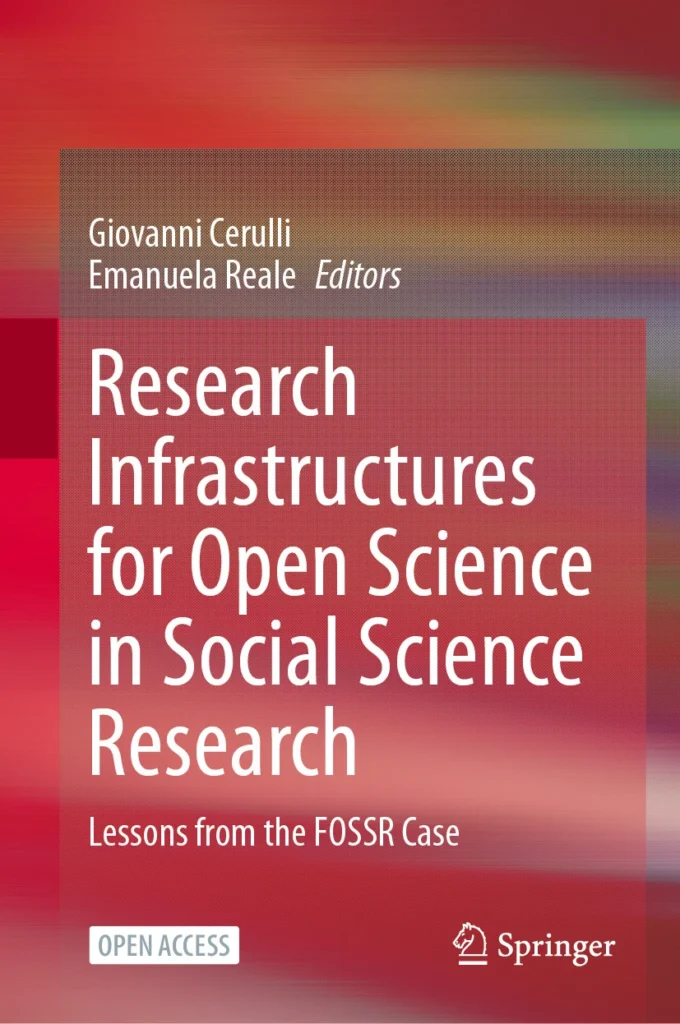
Springer Nature has published “Research Infrastructures for Open Science in Social Science Research: Lessons from the FOSSR Case”. The volume brings together the main results, tools and reflections developed during the FOSSR project. It is edited by Giovanni Cerulli and Emanuela Reale, who were Scientific Coordinators of FOSSR at different stages of the project.
The book is more than a summary of the project results. Starting from the FOSSR experience, it looks at how research infrastructures in the social sciences are changing and at the new tools needed to study societies that are becoming more complex, connected and rich in data.
The FOSSR Project was funded by the Italian National Recovery and Resilience Plan (PNRR) NextGenerationEU. Its aim was to strengthen research infrastructures for the social sciences in Italy by developing new data resources, digital services, analytical tools and computing capacities within the Open Science framework.
This broad idea of research infrastructure is one of the main themes of the book. Research infrastructures are no longer only places where data are stored. They are also environments that can connect data, technologies, methods and scientific communities.
The book starts from key topics in Open Science, including interoperability, FAIR principles, data governance, ethics and accessibility, and then shows how these ideas can be applied in practice.
One important area is the study of social change over time. New tools allow researchers not only to describe a population at a specific moment, but also to follow changes, transitions and developments during people’s lives.
Examples include the Italian Online Probability Panel and the Italian Life Course Observatory. These tools were created to study different stages of life and issues such as work, family, health, participation and ageing. The same approach is used by CIVES, an observatory focused on values, trust, civic and political participation, and changes in attitudes and opinions.
Experimental research is another important area of innovation. Through Poolpo, FOSSR developed a platform for large-scale online behavioural experiments. This creates new opportunities to compare results across studies and to repeat experiments in different settings.
The book also looks at the connection between research and public decision-making. The Policy Learning Platform combines causal inference and machine learning to evaluate policies and possible alternative scenarios. The aim is to provide stronger tools for evidence-based policymaking.
A large part of the volume is dedicated to Computational Social Science. It presents network analysis, knowledge graphs, agent-based models, machine learning, synthetic populations and forecasting systems. These are not treated as separate tools, but as parts of a new research infrastructure that can combine large amounts of data with methods from different disciplines.
The volume also looks at how knowledge is produced and shared. By combining data on publications, research projects, patents and collaborations, researchers can study the networks connecting universities, research organisations and companies. This can help explain how knowledge and innovation are created and spread in complex systems.
One of the main messages of the book is that Open Science is not only about making data open. It also requires infrastructures that make data truly usable, connected, verifiable and reusable, so that they can support the creation of new knowledge.
The publication of the book is an important milestone for FOSSR. The project is coming to an end, but its work continues through the tools, methods and ideas now available to the international scientific community through the FOSSR Research Infrastructure.
Publishing the volume in open access is also fully in line with the spirit of the project. What has been developed through FOSSR can now become a shared resource for the scientific community, a source of knowledge and a basis for the future development of research infrastructures for the social sciences.