




EN Funded by the European Union WHITE
LOGOBIANCO UniversitaRicerca Nolineare
italia domani

Online Research Panel (ORP)

The Online Research Panel (ORP) is a newly established voluntary panel composed of 10,000 adult residents of Italy. ORP composition was defined using quotas for age, gender, educational level, and geographical area (region and municipality size), with the aim of aligning it as closely as possible with the structure of the Italian 18+ population.

Operational since October 2025, the panel will be periodically renewed by replacing members who drop out, drawing on a reserve group of 1,500 individuals and recruiting new participants.

ORP enables the analysis of relationships, effects, and dynamics over time in social and economic phenomena, with costs and timelines compatible with ordinary research projects. To mitigate some of the limitations typical of opt-in panels, it applies post-stratification techniques that recalibrate the collected data to match population distributions.

ORP also makes it possible to explore new phenomena or those involving subpopulations for which probability sampling is impracticable, and it can respond rapidly to unforeseen events or urgent information needs, providing timely evidence to researchers and policymakers. Finally, it democratizes access to data collection, operating as a service inspired by the principles of Open Science.

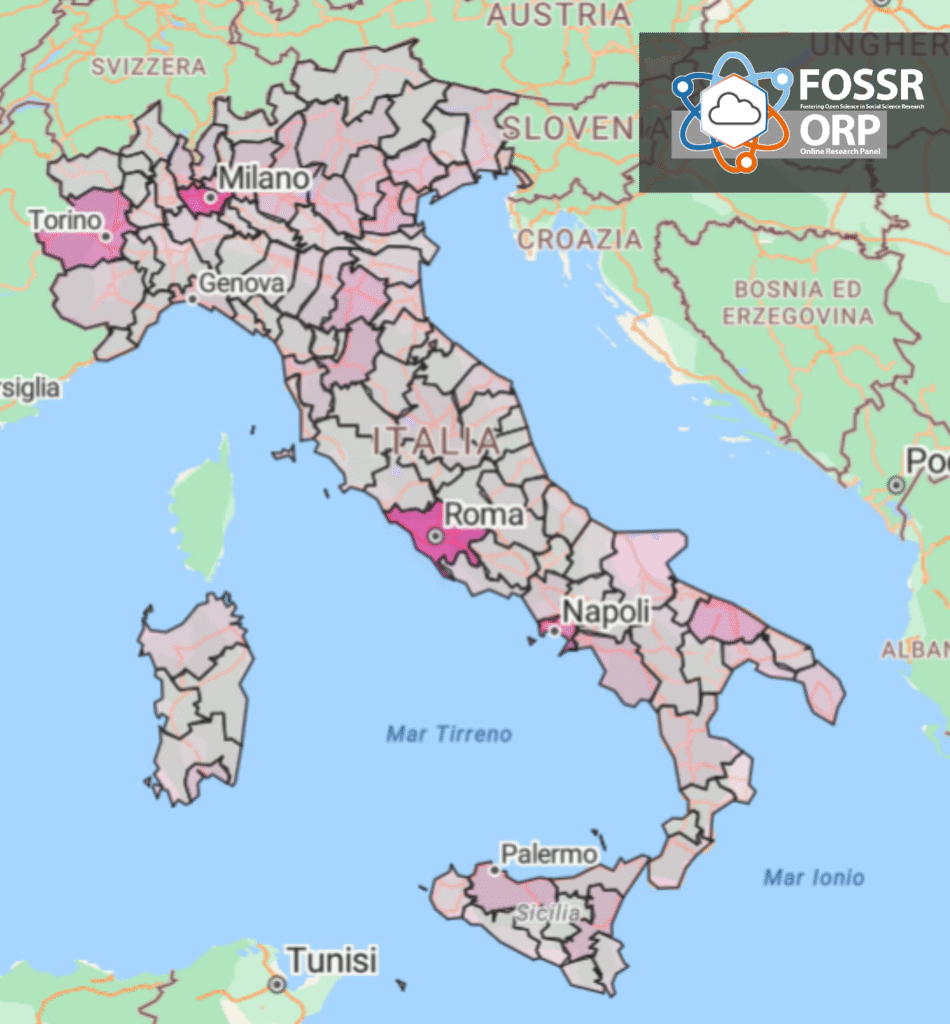
The Online Research Panel, through its surveys, enables a richer and more interconnected understanding of social phenomena, representing an innovative contribution both methodologically and in terms of knowledge production.

Service description

As part of the FOSSR project – Fostering Open Science in Social Science Research, funded by the European Union – NextGenerationEU, the Online Research Panel (ORP) was developed, a research panel accessible to researchers, academics and public agencies according to the principles of Open Science.

ORP is an open science service

Scholars, researchers, and doctoral students may access the panel to conduct online surveys by submitting a research project: once approved, they may survey ORP panel members on topics relevant to the social and economic sciences.

The collected data are open access

In addition to being shared with requesting researchers, survey data may be made available – after a process of anonymization – on the FOSSR open cloud platform, subject to approval of a research proposal.

In order to provide an accurate and diverse representation of the Italian population aged 18 and over, the Online Research Panel (ORP) is constantly open to new members.

Registration is open to all adults residing in Italy.

FOSSR-ORP adresses scholars and doctoral students at universities, researchers in public or private institutions and research centres, and representatives of statistical offices operating in the social, economic, and political sciences who:

  • need to collect original data through online surveys;
  • are interested in open research data for secondary analyses.

Objectives

ORP aims to support a wide range of applications useful both in academia and in decision-making processes. The main objectives are:

provide a flexible tool for data collection to support scientific research in the social and economic sciences through a panel of adults residing in Italy, suitable for conducting online surveys aimed at studying opinions, attitudes, and social behaviours;

support the dialogue between empirical research and public policy, contributing to the production of knowledge useful for addressing complex social challenges;

promote the use of open data, making the data collected through the various surveys available – anonymised – for secondary analysis, and ensuring fair and transparent access for scholars, researchers, and doctoral students interested in using an open science service.

Observatory on Civicness and Evolution of Society (CIVES Observatory)

matt mutlu 3zXNairD4xY unsplash cut

The CIVES Observatory is the main ORP survey, developed by CNR-IRCrES and the Carlo Cattaneo Research Foundation. It is a multi-topic, periodic survey designed to analyse in an integrated way the values, civic practices, and attitudes of the population with respect to key issues and challenges of contemporary society.

CIVES Observatory adopts a longitudinal approach, allowing for the monitoring of changes over time in the opinions and orientations of the adult population in Italy, with particular attention to the relationship between individuals, communities, and institutions. Its central core is the study of civicness.

The main topics investigated include:

levels and forms of civic and political participation, both conventional (e.g. membership in parties or unions, voting, participation in demonstrations or strikes) and informal or emerging (e.g. engagement in solidarity networks, solidarity purchase groups, energy or practice communities);

trust in national and international institutions (Parliament, local authorities, judicial system, law enforcement), as well as in the healthcare system, schools, science, and research;

political opinions and orientations toward parties, leaders, or political blocs; perceived importance of major public issues; priorities assigned to the national or European policy agenda;

value and cultural orientations, with particular attention to issues such as the European Union, climate change, social inequalities, civil rights, migration, and geopolitical conflicts;

visions of the future, propensity for cooperation, and willingness to collaborate with scientific research.

The survey also investigates dimensions often underexplored by major statistical surveys – such as conspiracy beliefs – or examined only discontinuously, such as attitudes toward climate change and mitigation policies.

The integrated analysis of multiple thematic areas makes it possible to identify complex social profiles that are often difficult to capture through sectoral approaches. This enables a richer and more interconnected understanding of social phenomena, representing an innovative contribution both methodologically and in terms of knowledge production.

Information

Per ulteriori informazioni: orp.fossr.eu/faq.

Insights

*pictures credits: Rob Curran and Matt Mutlu on Unsplash